
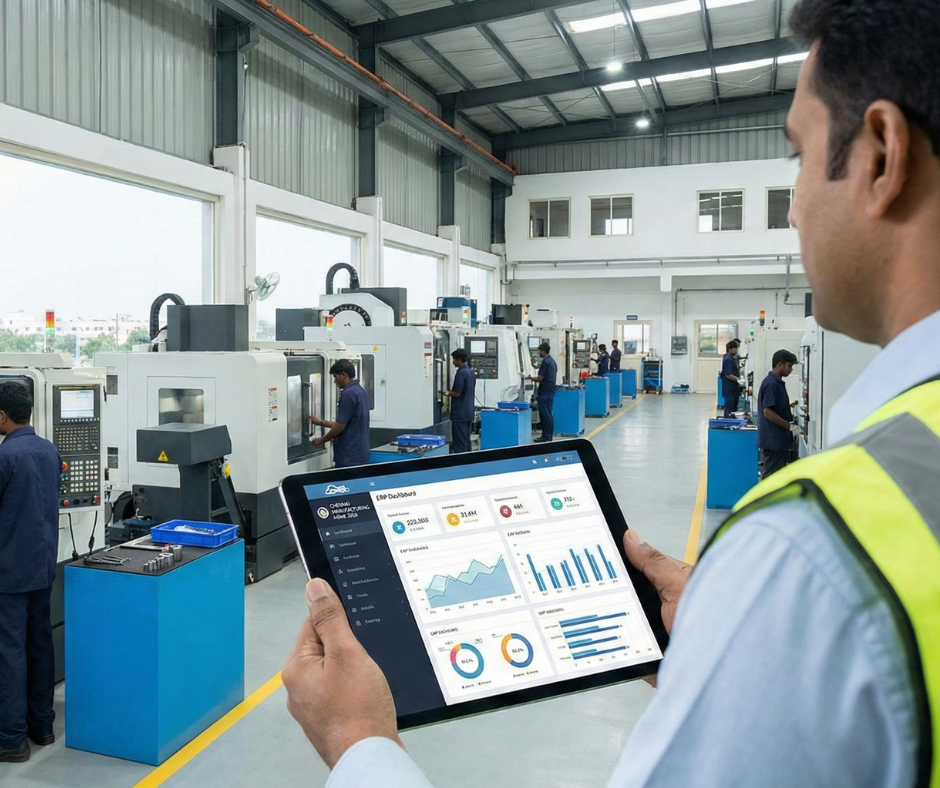
Why Manufacturing MSMEs in Chennai Need ERP in 2026
Chennai is one of India's most dynamic industrial corridors with clusters in automotive, engineering, plastics, textiles, and food processing, dominated by thousands of MSME suppliers. These units must manage complex production schedules, vendor dependencies, and compliance, while still operating with lean teams and tight working capital.
Key Pain Points ERP Solves
2026 Trends: ERP Adoption by Indian MSMEs
Across India, ERP for MSMEs is moving from "nice to have" to a competitive necessity, supported by Make in India, Digital India, and MSME digitisation programs. Cloud-based ERP is becoming especially attractive due to lower upfront cost, faster implementation, and remote access for multi-location units and sales teams.
Cloud First
Shift from on-premise to cloud ERP reducing capex and improving scalability.
Compliance Focus
Stronger focus on GST, e-invoicing, and e-way bill integration.
Industry-Specific
Solutions covering job work, subcontracting, and batch control.
Cloud vs On-Premise ERP for Chennai MSMEs
Cloud ERP for MSMEs
- Low upfront investment with subscription-based pricing
- Faster implementation and automatic updates
- Anytime-anywhere access for multi-location operations
On-Premise ERP for MSMEs
- Preferred when internet reliability is a challenge
- Higher initial capex but more infrastructure control
- Requires in-house IT team for maintenance
Must-Have Features in Manufacturing ERP Chennai MSMEs
Not every ERP is suitable for a manufacturing MSME. When selecting ERP software, Chennai factories should check for these must-have capabilities:
1End-to-End Production Management
- Multi-level BOM and routing for discrete, batch, and process manufacturing
- Production planning and scheduling that considers capacity, constraints, and priorities
- Shop-floor data capture for machine-wise production and downtime tracking
2Inventory and Material Control
- Real-time inventory across raw materials, WIP, finished goods, and consumables
- Material Requirement Planning (MRP) to generate purchase and production recommendations
- Batch, lot, and serial number tracking for traceability and quality audits
3Procurement and Vendor Management
- Purchase planning based on MRP, min-max levels, and lead times
- Vendor rating based on price, delivery performance, and quality
4Quality and Compliance
- In-process and final quality checks with sampling plans and rejection tracking
- Documentation for audits, certifications, and customer-specific quality requirements
5Finance, GST, and E-Invoicing
- Integrated financial accounting, AR/AP, cost centres, and project accounting
- GST-compliant invoicing, e-invoicing, and e-way bill generation
- Profitability analysis by product, customer, order, and plant
6Analytics and Dashboards
- Real-time MIS for management including production efficiency and OTIF delivery
- Drill-down reports from summary to transaction level for root-cause analysis
How to Evaluate ERP Vendors
Use this structured checklist while shortlisting manufacturing ERP Chennai solutions:
Local Understanding
Does the vendor have experience with Chennai industrial belts and typical MSME production setups?
Industry Fit
Are there successful implementations in your specific segment – auto components, fabrication, plastics, textiles, or food?
Implementation Approach
Does the team provide process mapping, data migration, training, and go-live support?
Flexibility
Can the system handle job work, subcontracting, rework, and engineering changes without heavy customisation?
Total Cost of Ownership
Beyond licence fees, consider implementation, training, AMC, infrastructure, and future user additions.
Support Quality
Is there responsive local or regional support with clear SLAs for issue resolution and enhancements?
Step-by-Step ERP Selection Process
Define Objectives
Clarify whether your primary focus is on delivery performance, inventory control, cost reduction, compliance, or all of the above.
Map Your Processes
Document key processes from enquiry-to-order, purchase-to-pay, plan-to-produce, and order-to-cash.
Prepare Feature Checklist
Mark what is essential, good-to-have, and optional for your business from the must-have features list.
Shortlist 3–4 Vendors
Choose vendors who specialise in manufacturing ERP Chennai MSME with references in your cluster.
Ask for Live Demos
Request demos using your real products, BOMs, and sample orders to see practical system behavior.
Talk to Existing Customers
Speak to 2–3 existing clients preferably MSMEs in your segment to understand implementation challenges.
Start with Phased Rollout
Begin with core modules like production, inventory, and finance, then extend to advanced features.