
Why Production Really Fails: Not Disruption, But Blindness
Every manufacturer knows that disruptions are part of daily life. Machines stop, subcontractors delay, material arrives late, and urgent customer orders suddenly reshuffle priorities. None of this is new. What turns these normal disruptions into real production failures is the lack of timely, accurate information.
When you don't know what has gone out to job work, what has returned, and what is still pending, you cannot respond quickly. Supervisors start making phone calls, sending messages, and chasing people for updates. Planners work with yesterday's reports. Top management receives optimistic status updates until it is too late. In this environment, there is no Plan B—only firefighting.
Factories that operate without a system rely on memory, Excel sheets, and informal follow-ups. This creates bottlenecks, hidden delays, and unplanned downtime that quietly erodes margins and delivery performance. The problem is not that things go wrong; the problem is that nobody sees the full impact in time to react.
What Is Real‑Time Job Work Tracking?
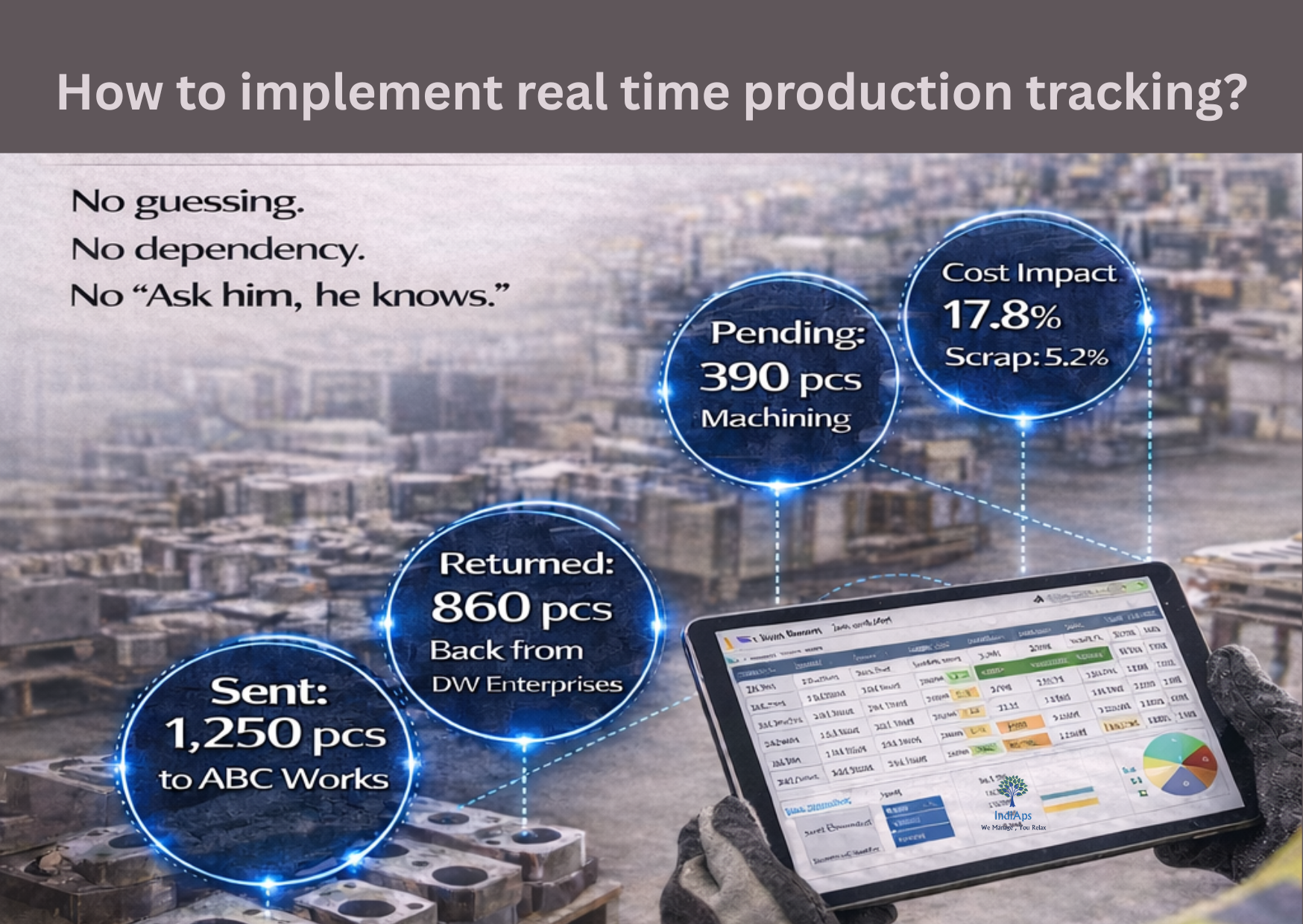
Real‑time job work tracking is the ability to see, at any moment, the exact status of every job that has been issued to subcontractors or internal work centers. A modern ERP‑driven job work module captures:
What material went out, with quantity, batch, and process details.
What has come back, including accepted quantity, rejections, and scrap.
What is still pending at each subcontractor or operation.
Subcontractor‑wise status and performance trends.
Cost impact in terms of process charges, scrap, and rework.
Instead of asking someone to "check the file" or "call the vendor," your team looks at a live dashboard and knows the truth instantly. This visibility is the foundation of a real Plan B.
From Follow‑Ups to Live Visibility
Traditional subcontracting and job work management in many factories still runs on gate passes, handwritten challans, and spreadsheets. When a customer calls asking about shipment status, the standard reaction is to chase information: check store registers, call the subcontractor, walk to the shop floor, and reconcile numbers manually.
Real‑time job work tracking flips this model:
You don't "follow up"; you see it live.
You don't depend on one person's memory; you rely on a shared system.
You don't guess about delays; you see which jobs are slipping and why.
Manufacturers using real‑time tracking report better understanding of process bottlenecks, faster reaction to problems, and measurable improvements in efficiency and on‑time delivery. This is the difference between factories that panic and those that adapt.
Six Visibility Pillars Every Factory Needs
Every factory needs six powerful visibility pillars to protect production and support a Plan B.
What Went Out
Knowing exactly what was sent—item, quantity, batch, process, and subcontractor—is the starting point of control.
What Came Back
Real‑time tracking records each return with received quantity, accepted quantity, rejection reasons, and scrap.
What Is Still Pending
If planners know exactly which lots are pending, they can reschedule jobs and arrange alternate vendors.
Subcontractor‑Wise Status
A good job work tracking system provides subcontractor‑wise dashboards showing jobs issued vs. completed.
Cost Impact
Real‑time tracking ties each job to process charges, scrap cost, rework, and delay impact on orders.
Early Delay Detection
Real‑time systems send alerts when jobs cross expected cycle times and catch issues before they grow.
How IndiAps ERP Nxt Delivers Real‑Time Job Work Tracking
IndiAps ERP Nxt is designed for manufacturing and subcontracting environments where thousands of components move in and out of plants every month. Its job work and subcontracting module provides:
Digital gate passes and issue notes for every outward movement.
Automatic stock updates and third‑party stock ledgers.
Job work receipts with inspection results, scrap booking, and rework tracking.
Subcontractor‑wise and operation‑wise dashboards for live monitoring.
Costing that rolls up process charges and scrap into finished goods.
By integrating job work with production planning, inventory, purchase, and finance, IndiAps creates a seamless view of the entire manufacturing chain—from raw materials to dispatch. This end‑to‑end visibility gives managers confidence that the data they see is complete and current.
From Panic to Adaptation: Factories with Systems vs. Factories without
The difference between factories "without systems" and factories "with systems" is easy to imagine in a typical disruption scenario. Picture this:
A critical machine fails in the machining line.
A subcontractor informs that they will be late by two days.
A priority export order is confirmed, pulling capacity away from existing jobs.
In a factory without a system, chaos follows: meetings, phone calls, blame, and hurried adjustments based on partial information. In a factory running IndiAps ERP Nxt with real‑time job work tracking, the response is different:
Supervisors instantly see which jobs are in queue, which can be moved, and where capacity is available.
Planners review live subcontractor status and reassign work where possible.
Management sees the impact on dispatch commitments and can reset customer expectations early.
The disruption still happened—but the factory adapted instead of panicking. Real‑time visibility gave them a Plan B.
When You Have Visibility, You Always Have a Plan B
Production will always face disruptions—machines will stop, material will get delayed, and urgent orders will interrupt the best schedules. What separates resilient factories from the rest is not luck, but visibility. With real‑time job work tracking in IndiAps ERP Nxt, you know what went out, what came back, what is pending, where it is stuck, and what it is costing you.
Factories without systems panic. Factories with systems adapt. IndiAps ERP Nxt gives you the visibility to track, the controls to respond, and the insights to improve—so your production never fails in silence again.