
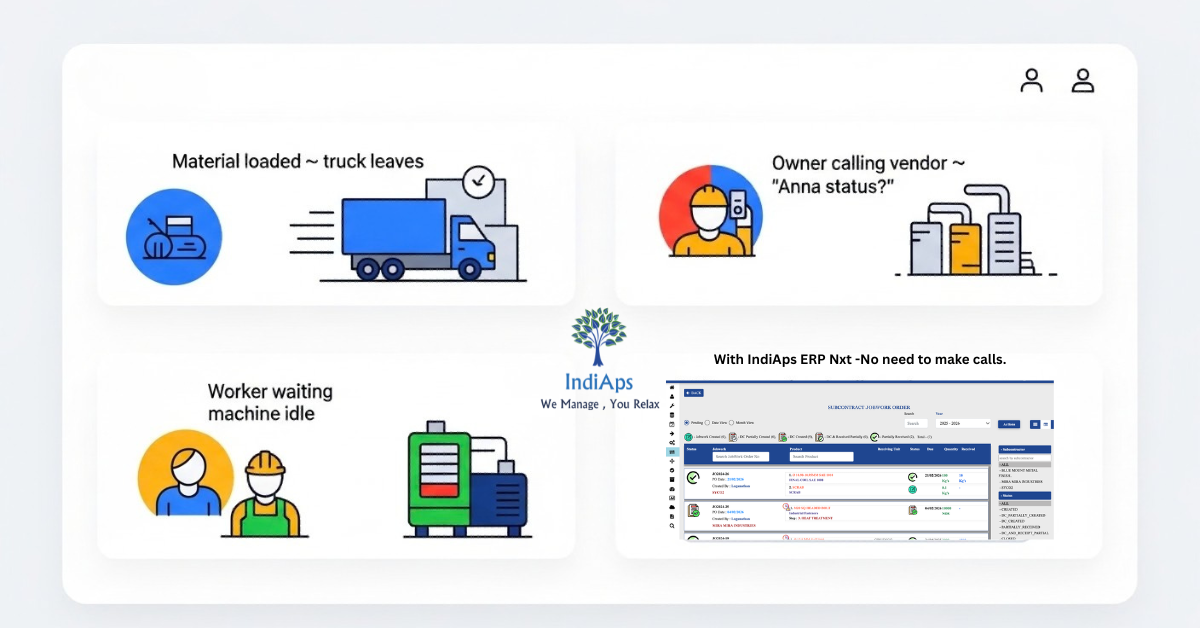
"The moment material goes to subcontract, visibility drops. You depend on calls. You depend on promises. Production waits. Strong factories don't chase status. They see it."
1. The Moment Material Goes to Subcontract, Visibility Drops
In most factories, the shopfloor is reasonably controlled until the material leaves your gate for jobwork. The moment it moves to a subcontractor, visibility collapses: you depend on calls, WhatsApp messages, and verbal promises. Production plans slip because nobody can say confidently how much is in machining, how much is waiting for heat treatment, and what is actually ready to dispatch back.
This is not a minor nuisance is a structural visibility gap in your manufacturing system. Studies across industries show that leaders still have limited real-time visibility over outsourced operations, which directly contributes to late deliveries, expediting, and firefighting.
2. The Real Cost of "Call-Based" Subcontract Tracking
Relying on calls and spreadsheets to manage subcontractors creates several hidden losses:
Missed production commitments: When subcontract status is unclear, planners either over-commit or keep excess buffer, both of which hurt OTD and working capital.
Hidden cost creep: Extra issues of material, rework, and unbilled operations often surface only during costing or reconciliation because there is no single source of truth across vendors and internal teams.
Quality and responsibility gaps: Without digital traceability, it is difficult to pinpoint which batch, which subcontractor, or which operation caused a quality failure.
Admin overload: Buyers and PPC teams waste hours every week chasing status on phone, updating Excel trackers, and reconciling gate passes with physical stock.
In a competitive market, these leakages directly reduce margins and weaken customer trust.
3. What "Real Subcontract Visibility" Should Look Like
A modern factory should be able to answer, in one screen:
- •How much material is lying at each subcontractor, operation-wise.
- •For each jobwork order: issued quantity, in-process quantity, completed-but-not-dispatched quantity, and received quantity.
- •Operation stage of every lot – machining, heat treatment, grinding, plating, etc.
- •Expected return date by lot, and its impact on production orders and dispatch commitments.
Leading manufacturers now treat subcontract visibility as a strategic ERP requirement, not an optional add-on, because so much value creation happens outside their own premises. When this data flows in real time, planners can simulate "what if" scenarios, reschedule intelligently, and keep customers informed with confidence.
4. How IndiAps ERP Nxt Gives You End-to-End Subcontract Visibility
IndiAps ERP Nxt is designed for Indian manufacturing units that rely heavily on jobwork – machining, fabrication, heat treatment, surface coating, and more. Here are the key capabilities:
Lot-wise Subcontract Tracking
Every jobwork is linked to the production order, BOM, and subcontractor. Always know what is where across vendors.
Real-time Movement Visibility
Gate passes and GRNs update the live stock ledger so third-party stock is visible across teams.
Process-Stage Tracking
Record current operation for multi-stage jobwork and see stage-wise bottlenecks instead of opaque status.
Expected Return & Delay Alerts
Automatic alerts on overdue lots and at-risk production orders days in advance.
Automatic Costing & Reconciliation
Receipt updates job cost automatically and plugs leakages from excess scrap and rate deviations.
Integrated Quality Capture
QC results, rework, and rejections feed supplier scorecards and future sourcing decisions.
5. From Chasing Status to Seeing It
Before IndiAps ERP Nxt: A precision components manufacturer sends crankcases to three different subcontractors for machining and surface treatment. PPC keeps a colour-coded Excel, buyers keep vendor-wise WhatsApp groups, and stores reconciles gate passes at month-end. Production frequently waits because a critical lot is still "on the way" or "almost done" according to phone updates.
After IndiAps ERP Nxt: The same team sees, on one screen, how many crankcases are at each subcontractor, at which operation, and which lots are overdue against the production plan. The system automatically highlights lots that can impact next week's assembly schedule and shows material lying idle at vendors beyond agreed lead time. Buyers spend less time following up and more time negotiating rates and developing new vendors.
"Strong factories don't chase subcontract status. They see it – by making subcontract jobwork a first-class citizen inside their ERP, not an Excel afterthought. If your production still waits on phone updates, it's time to upgrade to IndiAps ERP Nxt."